
November Is Radon Action Month: A Good Time to Test Your Home
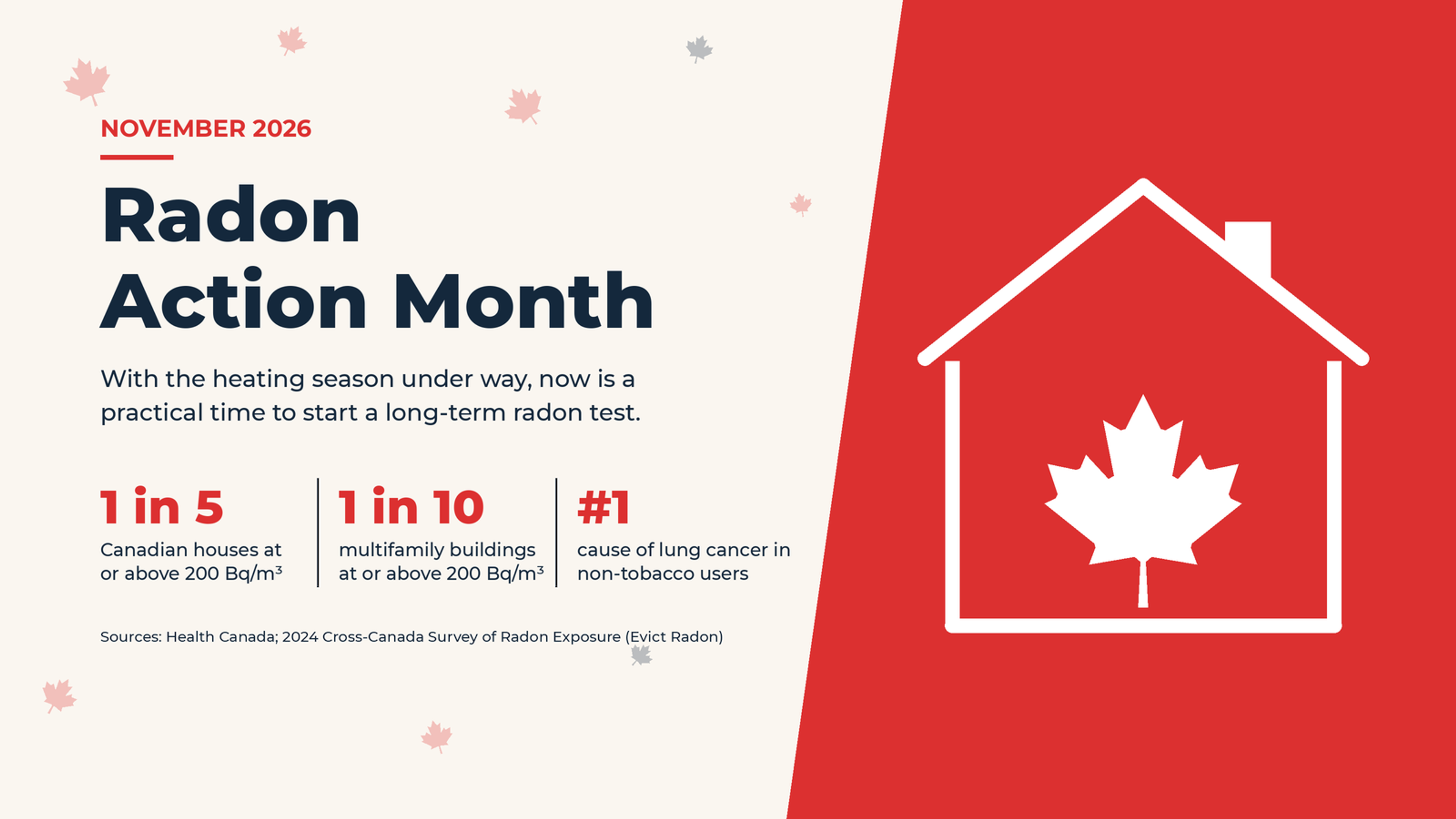
November is Radon Action Month, a reminder for Canadians to test their homes for a gas they can’t see, smell, or taste. With the heating season under way across much of the country, now is a practical time to start a long-term test.
Radon is a naturally occurring radioactive gas that can be drawn into homes by differences in air pressure, entering from the ground through cracks in foundations and gaps around pipes as well as water supplies. Long-term exposure increases the risk of lung cancer, and radon is the leading cause of lung cancer among people who do not use tobacco in Canada. Because levels can vary considerably even between neighboring homes, testing is the only way to know the level in your own home.
The 2024 Cross-Canada Survey of Radon Exposure, conducted by the Evict Radon National Study team, estimated that nearly 1 in 5 of Canadian houses have radon levels at or above the national guideline of 200 Bq/m³. The estimate covers detached, semi-detached, and row houses, and highlights the importance of testing homes in every part of the country. Preliminary findings also showed that approximately 1 in 10 multifamily buildings surveyed, mostly low-rise apartment buildings, had radon levels at or above 200 Bq/m³.
Why the heating season matters
In colder weather, windows and doors stay closed and ventilation drops. Warm air rising inside the home can also draw more radon in from the soil. Together, these conditions often lead to higher indoor radon levels.
Health Canada recommends a long-term test lasting at least three months, and ideally up to 12 months, carried out during the fall and winter. Longer tests account for fluctuations caused by weather, ventilation, and everyday activities. Starting in November lets you measure through the coldest months, when radon levels tend to be highest.
“A long-term radon test is one of the simplest things you can do for your home’s health. It takes a few minutes to set up, costs around $60-80, and then quietly measures for three months or more while you go about your life. Because radon levels change from day to day, a longer test gives you a far more reliable answer about whether your home needs attention,” says Benjamin Portin, Vice President, North America, at Radonova.
A simple process at home
With a passive test kit such as Radonova’s Radtrak long-term radon test, you place the detector as described in the instructions and register the start date in MyPages, Radonova’s online portal.
Health Canada recommends placing the detector in a room on the lowest lived-in level of your home where someone spends four or more hours per day, such as a bedroom, living room, or office. Leave it undisturbed for the full test period and go about your normal routine. When the test is over, register the end date and promptly return the detector to the laboratory for analysis.
Testing is especially worthwhile if your home has never been tested. Major renovations, changes to ventilation, or converting a basement into living space are also good reasons to test again.
What to do with the result
If your long-term result is above 200 Bq/m³, Health Canada recommends reducing radon levels. Corrective action should be taken within one year, and sooner at higher radon levels, to reduce levels to as low as practically possible. A C-NRPP-certified radon mitigation professional can assess your home and recommend a suitable solution.
A small step with lasting benefits
Radon is the leading cause of lung cancer among people who do not use tobacco in Canada, but it is also one of the most preventable. Mitigation is usually straightforward, and most homes can be brought below the guideline with a single system. The hardest part is knowing whether you have a problem in the first place.
This November, take a few minutes to start a long-term test. By spring, you’ll have a reliable answer about the air your family breathes every day. If action is needed, you’ll have time to mitigate over the summer and run a follow-up test next fall to confirm the results.
Related News

September 28, 2026

November 19, 2025